Best Organic Traffic Platforms for Affiliate Marketing In 2026
If you want to build an affiliate marketing business without constantly paying for advertising, organic traffic is one of the most valuable assets you can build
The good news is that you are no longer limited to Google search. In 2026, affiliate marketers can attract potential customers through Facebook, YouTube, blogs, TikTok, podcasts, Pinterest, Reddit, and email marketing
But which organic traffic platform is actually worth your time?
In my opinion, Facebook deserves more attention than many beginners give it. Its combination of communities, groups, short-form video, discussions, pages, and personal profiles can make it a powerful traffic source for affiliate marketers especially when you know how to provide value instead of simply dropping affiliate links.
Let’s look at the best organic traffic platforms for affiliate marketing in 2026 and how you can use them.
Quick Answer: What Is the Best Organic Traffic Platform for Affiliate Marketing?
For many beginners, I would start with Facebook, while building a blog as your long-term asset.
Facebook can help you start conversations, build a community, share useful content, and send interested people to your website. A blog, on the other hand, gives you a website you own and a place where you can publish detailed reviews, comparisons, tutorials, and other affiliate content.
YouTube is another excellent option if you are comfortable creating videos, while TikTok can be useful for fast discovery and short-form content.
The best strategy is not necessarily choosing only one platform. It is creating one useful piece of content and repurposing it across multiple organic traffic channels.
1. Facebook
If I had to choose one social platform to test first for affiliate marketing in 2026, Facebook would be near the top of my list.
Why?
Because Facebook is more than a place for short posts. You have Facebook Groups, Pages, personal profiles, Reels, video, comments, communities, and increasingly personalized content recommendations.
Meta has continued investing in Facebook’s recommendation and creator systems. In 2026, Meta reported improvements in organic Feed and video views and continued to develop tools designed to help creators understand their audiences and improve their content.
That creates several opportunities for affiliate marketers.
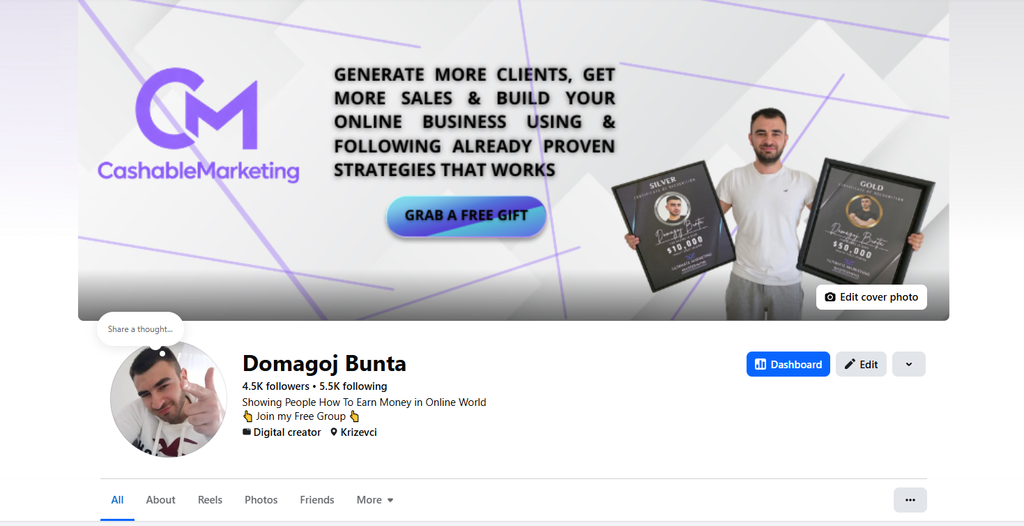
Example of my profile that made me loads and loads of cash.
Facebook Groups
Groups can be especially interesting if your affiliate niche has an active community.
For example, imagine you promote:
- Website hosting
- AI tools
- Online business software
- Fitness products
- Travel products
- Photography equipment
- Software subscriptions
- Online courses
Instead of simply posting:
“Buy this product through my link.”
You can answer questions, create useful discussions, share tutorials, explain mistakes to avoid, and occasionally recommend relevant solutions.
The important part is help first, promotion second.
You should also check the rules of each Facebook Group before posting promotional or affiliate content. Some groups completely prohibit affiliate links.
Facebook Reels
You can also use short videos to attract people who have never heard of you.
For example:
“3 AI tools every beginner should know”
or
“5 mistakes beginners make when starting affiliate marketing”
Then you can direct interested viewers toward a relevant article on your website.
Facebook has also stated that original content is being prioritized in Feed and Reels, while duplicated or low-value reused content can be deprioritized.
That means simply copying other people’s videos and adding a few words is not a strategy I would build a business around.
Create something useful and add your own perspective.
Facebook Pages and Profiles
A Facebook Page can become a central place for your content, while a personal or professional profile can help you build a stronger connection with your audience.
The biggest advantage of Facebook, in my opinion, is the community aspect.
People can comment, ask questions, disagree with you, and start conversations.
Those conversations can reveal exactly what your audience wants to know which can then become your next blog post, video, Reel, or affiliate review.
My Facebook Strategy for Affiliate Marketing
If I were starting from zero, I would try this:
- Choose one specific niche.
- Join relevant Facebook Groups.
- Study the questions people ask repeatedly.
- Turn those questions into useful content.
- Publish original posts and Reels.
- Link to helpful articles on your website when appropriate.
- Build relationships instead of constantly promoting products.
Facebook is not about posting affiliate links everywhere. It’s about building attention and trust.
And that is exactly what makes it interesting for affiliate marketing.
If You want to go with Facebook here is one cool course that can help you to start with basics >CLICK HERE TO CHECK IT OUT<
2. Blog
A blog is still one of the most important organic traffic assets for an affiliate marketer.
Unlike a social media profile, your website gives you much more control over your content and how you structure your affiliate business.
You can create:
- Product reviews
- Comparison articles
- “Best X” lists
- Tutorials
- How-to guides
- Beginner guides
- Software reviews
- Alternatives articles
- Problem-solving content
- Frequently asked questions
For example, instead of writing a generic article about AI, you could target a much more specific topic:
“Best AI Tools for Small Businesses in 2026”
Or:
“Best Website Hosting for Affiliate Marketing Beginners”
The more specific the search intent, the easier it is to understand what the reader actually wants.
Google’s current guidance emphasizes helpful, reliable, people first content rather than content created primarily to manipulate rankings.
That is especially important for affiliate websites.
Don’t create 100 thin articles just because you want more pages indexed.
Create fewer, more useful articles that genuinely answer questions.
Why Your Blog Matters
Your social media accounts can send visitors to your website.
Your YouTube videos can send visitors to your website.
Your TikTok videos can send visitors to your website.
Your podcast can send visitors to your website.
Your email list can send visitors to your website.
That makes your blog the central hub of your affiliate marketing strategy.
3. YouTube
YouTube is one of the strongest organic platforms for affiliate marketing because people actively search for information before buying products and services.
Think about searches such as:
- “Best AI tools for beginners”
- “Hostinger review”
- “Best microphone for podcasting”
- “How to start affiliate marketing”
- “Best website builder for small business”
- “Best laptops for content creators”
These are often connected to buying decisions.
You can create tutorials, reviews, comparisons, demonstrations, and educational videos around those topics.
YouTube’s own documentation explains that Search considers factors such as relevance, engagement, and quality, while recommendations are personalized based on viewer interests and behavior.
That means a good video can potentially continue attracting viewers long after you publish it.
You don’t necessarily need expensive equipment either.
A useful screen recording, clear explanation, and good audio can be enough to start.
And if you don’t want to appear on camera, you can create tutorials, screen recordings, presentations, or voice-over videos.
4. TikTok
TikTok is another interesting organic traffic platform for affiliate marketers, particularly for short-form educational and product-focused content.
The biggest advantage is discovery.
Someone doesn’t necessarily need to follow you to discover your content.
You can create short videos such as:
“3 websites every online business beginner should know”
“This AI tool can save you hours every week”
“Don’t buy this before checking these 3 things”
The key is creating content around a specific problem rather than making every video a sales pitch.
TikTok itself describes the platform as a place where people discover new things, and its 2026 product developments continue to focus heavily on discovery and search.
For affiliate marketing, this makes TikTok particularly interesting for:
- AI tools
- Software
- Beauty
- Fitness
- Gadgets
- Fashion
- Online business
- Productivity
- Travel
The challenge is that short form content can require consistent publishing.
One viral video is nice, but a repeatable content system is much more valuable.
5. Podcasting
Podcasting is usually slower than Facebook or TikTok when it comes to generating traffic, but it can create something extremely valuable:
trust.
People may spend 30, 60, or even 90 minutes listening to you.
That gives you significantly more time to explain a product, discuss a problem, tell a story, or teach something useful.
For affiliate marketing, you could create a podcast around your niche and naturally mention tools, products, or services that you actually use or believe are relevant.
For example:
Online Business for Beginners
could cover:
- Affiliate marketing
- AI tools
- Website building
- Productivity
- Content creation
- Online income strategies
You can then direct listeners to your website for detailed guides, comparisons, and additional resources.
The downside is simple: podcasting usually requires more commitment.
You need good audio, consistent episodes, and patience.
6. Pinterest
Pinterest is sometimes overlooked by affiliate marketers, but it can be useful for niches where people actively search for ideas and recommendations.
Examples include:
- Home and lifestyle
- Travel
- Food
- Fashion
- Beauty
- DIY
- Personal finance
- Productivity
- Business
- Blogging
You can create visual pins that lead people to useful articles on your website.
For example:
“10 Best AI Tools for Small Business Owners”
could become:
- A blog post
- A Pinterest graphic
- A Facebook post
- A YouTube video
- A TikTok
- An email
One topic can therefore produce multiple pieces of content.
7. Reddit
Reddit can be extremely valuable for research and community driven traffic, but you need to approach it carefully.
Reddit users generally don’t want to see obvious promotional spam.
Instead, participate in relevant communities, answer questions, share useful experiences, and understand the culture of each subreddit.
If someone asks:
“What is the easiest way to build a website as a beginner?”
a genuinely helpful answer can be much more effective than simply posting an affiliate link.
Always follow subreddit rules.
If promotional links are not allowed, don’t post them.
The goal should be to become a useful member of the community rather than someone who appears only when there is an opportunity to make a commission.
8. Email Marketing
Email isn’t technically a discovery platform in the same way as Facebook or TikTok, but it can become one of your most valuable organic traffic assets.
Why?
Because you don’t have to depend completely on an algorithm.
Someone gives you permission to contact them, and you can send them useful information directly.
For example, your website could offer a free:
“Beginner’s Guide to Affiliate Marketing”
in exchange for an email address.
You can then send:
- New blog posts
- Tutorials
- Product comparisons
- Helpful tips
- Case studies
- Recommended tools
- Special offers
Email is particularly powerful when combined with a blog.
Someone might discover you through Facebook today, read your blog tomorrow, subscribe to your email list, and eventually purchase a product through your affiliate link.
That’s how different traffic channels can work together.
The Best Organic Traffic Strategy for Affiliate Marketing
I don’t think you should try to become an expert on every platform at the same time.
That is one of the biggest mistakes beginners make.
Instead, focus on the one platform till you master it. I would suggest you Facebook, also Facebook is 1st platform that made me my first 1.000$, my first 10.000$ and my first 100.000$ it is really simple and fastest to reach bigger numbers if you are ready to show your face
But to get back where I started, take one platform and master it, build skill set, build audience and later leverage all of that to another platform it will be much much easier.
If you go on couple platforms at once, you will just be all over the place all the time and you will never be good at one platform and really soon you will found yourself burned out and on edge to quit
At beginning Less is more!
Facebook vs. YouTube vs. Blog vs. TikTok
There isn’t one platform that is perfect for every affiliate marketer.
Here’s how I would think about them:
| Platform | Best For | Main Advantage |
|---|---|---|
| Beginners & communities | Groups, conversations, Reels and sharing | |
| Blog | Long-term affiliate SEO | You own the website and content |
| YouTube | Reviews & tutorials | Search + video + trust |
| TikTok | Short-form discovery | Fast content discovery |
| Podcast | Authority & trust | Long-form audience connection |
| Visual niches | Evergreen content discovery | |
| Research & communities | High-value discussions | |
| Returning visitors | Direct relationship with your audience |
If you ask me where I would start, I would probably combine Facebook + Blog.
Facebook gives you a place to interact with people and discover what they care about.
Your blog gives you a place to publish deeper content and build a long-term asset.
Then I would gradually add YouTube or TikTok depending on whether I preferred long-form or short-form video.
How to Get Organic Traffic Without Spamming Affiliate Links
This is important.
Affiliate marketing works much better when people trust your recommendations.
Instead of constantly saying:
“Buy this.”
try creating content that answers:
“What problem are you trying to solve?”
For example:
Instead of:
“Best AI Tool — Buy Now”
create:
“7 AI Tools That Can Save a Small Business Hours Every Week”
Instead of:
“Buy This Website Hosting”
create:
“How to Choose Website Hosting as a Complete Beginner”
The second approach gives you much more room to educate the reader before making a recommendation.
And it creates content that can work across multiple platforms.
Final Thoughts
There are plenty of organic traffic platforms available to affiliate marketers in 2026, but you don’t need to use all of them.
If you’re a beginner, I would focus on Facebook and your own blog first.
Facebook is particularly interesting because it combines communities, discussions, profiles, Pages, Reels, and content recommendations. Meta is continuing to invest heavily in creator discovery, original content, and AI-powered tools on the platform.
Your blog, meanwhile, gives you a place to build a library of useful content that can attract visitors from search and from every other platform you use.
Then you can expand into YouTube, TikTok, Pinterest, Reddit, podcasting, and email marketing.
The real advantage doesn’t come from being everywhere.
It comes from taking one useful idea and turning it into multiple pieces of content.
For affiliate marketing, the goal isn’t simply to get as much traffic as possible.
The goal is to attract the right people, answer their questions, build trust, and help them make better buying decisions.
That is the kind of organic traffic that can eventually turn into a sustainable affiliate business.
Frequently Asked Questions
What is the best organic traffic platform for affiliate marketing in 2026?
For many beginners, Facebook is a strong starting point because it combines Groups, Pages, profiles, Reels, discussions, and content discovery. A blog should also be part of the long-term strategy because it gives you an owned platform for publishing affiliate content.
Is Facebook good for affiliate marketing?
Yes. Facebook can be useful for affiliate marketing when you focus on helpful content, community participation, discussions, and original videos rather than constantly posting affiliate links. Always follow the rules of individual Facebook Groups and applicable platform policies.
Can I do affiliate marketing without paid ads?
Yes. You can build organic traffic through Facebook, Google Search, YouTube, TikTok, Pinterest, Reddit, podcasts, and email marketing. The trade-off is that organic traffic usually requires consistent content creation and patience.
Is blogging still worth it for affiliate marketing?
Yes. A blog can serve as the central hub for your affiliate content, including reviews, comparisons, tutorials, guides, and other useful articles. It can also receive visitors from social media, video platforms, search engines, and email.
Which is better for affiliate marketing: Facebook or TikTok?
They serve different purposes. Facebook is particularly useful for communities, discussions, groups, and a mix of text, video, and social content. TikTok is heavily focused on short-form discovery. Your niche and content style should determine which one receives more of your attention.
How do I get organic traffic to an affiliate website?
Create useful content around problems your target audience is actively trying to solve. Publish detailed blog articles, answer questions in relevant communities, create videos, build an email list, and repurpose your best ideas across multiple platforms.
Can social media traffic help my affiliate website?
Yes. Social media can introduce your content to people who may later visit your website, join your email list, or purchase a product through an affiliate link. The strongest approach is usually to use social platforms to build attention and your website to provide deeper information.
Affiliate Disclosure
This article contains affiliate links. If you make a purchase through one of these links, I may earn a commission at no additional cost to you. I only recommend products and services I believe may be useful to my readers.